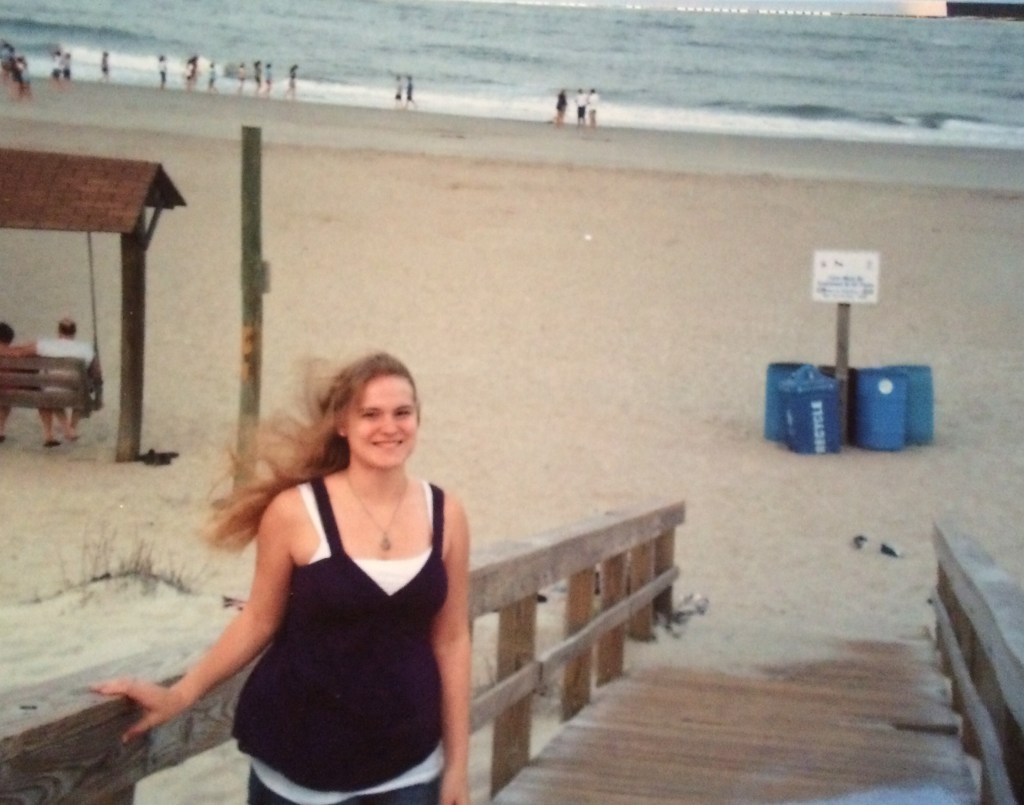
In a couple of minutes my family will do what they haven’t in years. That is, we will cram ourselves in a not-big-enough vehicle and embark on a too-many-hours long road trip somewhere where we will probably be eaten by bears or mountain lions (Colorado, in this case). We haven’t been on an out of state family vacation since I graduated high school five years ago, so it will be interesting to say the least. I have to quick get a post in before we leave because I have no idea when I’ll have WiFi again, so I thought I’d give you a glimpse of vacations past with a creative nonfiction essay I wrote in college about a few of my family’s last out of state endeavors. So, without further ado:
TWILIGHT ON TYBEE
With every step my bare feet sink into small mountains of fine sand. Darkness encloses the small Georgian island, but the moon casts a path of light before me, shimmering a glow on the short bridge to the beach. I take my camera out of my pocket and watch the light through the screen. The scent of fresh ocean salt rushes my nose as I grow steadily closer to the waves beating the shore. The worn wooden planks give way to sand packed and hardened by the tides, creating a surface almost like wet concrete.
The island itself is nothing exceptional. The twenty-one square miles enclose suburban housing and civil war sites to the north and marshland and the mouth of the Savannah River to the west. Eccentric cottages, restaurants, and shops, painted in neon hues and adorned with sea shells, line the crescent beaches of the south and the east. Many of these are still remnants from the 1950’s, when Tybee was known as “Savannah’s Beach,” a personal playground for southeastern Georgia’s prominent families. Over the years, this population expanded to include Hollywood celebrities, famous chefs, spring breakers from the University of Georgia, and even small Minnesotan families on vacation, outnumbering the humble locals three to one.
To me, the island is merely an observation point. I’d read several months before that Tybee Island had a magical sunrise, with life changing capabilities. Somehow, between the blending of color and rising light, answers were just supposed to come. After my grandmother’s death the previous summer, I’d felt I needed an escape. It was my turn to pick our annual family vacation spot, so somehow, eight months later I found myself there, determined to watch the supposedly magical sunrise.
4:45 a.m. Sun Eighteen Degrees Below Horizon.
Prior to Astronomical Twilight, the sky is completely dark. It comes just as the first sign of light spreads across the sky, turning everything a dark, hazy blue. At night, Astronomical Twilight means the moment the light in sky switches off, blanketing everything in blackness. It’s a term meaning both the inevitability and relief of darkness.
As I tread on the hardened sand, I twist my flashlight from side to side, slicing the blue haze with blades of light and keep my camera recording with the other. The beam sends ghost crabs scurrying across the beach into the cover of untamed brush and discarded beer cans near the bridge. Even though it’s nearly seventy degrees, a sea breeze chills the morning air, and I zip my jacket as I walk on.
Two years before Tybee, my brother chose our vacation, and our family took a road trip to Rossland, British Columbia, where one day we toured the LeRoi Mine near town. Before we could enter, we had to do three things: cover our shoulders with blankets to protect our clothes from leaks, put on electric blue plastic hard hats to protect our heads from falling rocks, and sign a waiver to protect the mine from being sued in case the hats didn’t work.
The entrance of the mine was a rickety wooden door tucked inside a mass of imposing black rock. Feeling the slick plastic of my hard hat and gazing up at the tower of jagged black stone, I couldn’t help picturing it all collapsing and hoped those waivers wouldn’t be necessary. Outside, the fresh air swirled with gentle summer breezes filled with the lingering scent of spruce and mountain greenery. As soon as I crossed the stone threshold into the dark mine, smells of mildew and wet dirt hit me. Our large group huddled together in the blackness, constricted between two narrow walls of rough stone. The tour guide flicked on a light switch and a line of flickering bare bulbs cast eerie yellow circles upon the dirt floor ahead of us. I rubbed my hands along the sleeves of my white sweatshirt and tugged the blanket tighter around me. As we followed the guide downhill, each step brought new chills a world away from the eighty degree weather outside.
Down into the dank gloom we descended, passing broken wooden carts and fenced drop offs. The tour guide had us each pick up a small rock and toss it over one of the wooden fences. Over the side, the yellow light only spread a few yards down in the narrow hole, giving in to complete darkness. The air over the drop was tinged with a hint of musty disuse, the scent of abandonment. My small stone fell from my hand into the pit below. Silence fell over us, with only the steady dripping from the low tunnel ceiling letting us know we could still hear. Then a tiny sprinkle of rock against stone echoed up through the mine, telling us if we jumped the fence, we would not survive the fall. White flashes from somebody’s camera illuminated the gaping gorge for a second before it surrendered once more to darkness. I moved quickly from the spot, reaching out for the support of a roughly hewn wall, thankful for confined space. Far ahead an old wooden staircase wound up through the stone, leading to a glimpse of sunlight beyond the darkness.
5:20 a.m. Sun Twelve Degrees Below Horizon.
During Nautical Twilight, just enough light exists to see vague objects in the hazy gloom. Ahead of me, the faint outline of the pier juts out to sea, towering over the sand and waves. Palm trees illuminated by the occasional iron lamppost sway slightly in the ocean wind. The moon still sits in the sky, its pale face gradually starting to blush. My feet sink into the cool sand as I walk over to the octagonal pavilion that marks the entrance to the wooden pier. Behind me I hear the rustling of raccoons in the brush, searching for their buried treasure of turtle eggs.
When I was two my mother chose our family trip to Wisconsin Dells. Since I was so young, I don’t remember anything about the trip, but in the video, past the footage of giant buffalo statues and hungry goats, my parents taped my escapades in the hotel room.
Black and white static flashes for a few seconds before a color picture fills the screen. A wooden door hangs slightly ajar in a narrow white hallway. Through the crack in the doorway, a small hazel eye shows at about knee height. My toddler eye reflects the lens for a second before I glare and shut the door. The camera captures the sound of a small lock turning into place.
“Emily,” my mother’s soft voice coos to me, glancing from the camera to the closed door. “Unlock the door.”
I start to giggle inside the hotel bathroom before my parents hear a distinct splash.
The picture flickers for a few seconds before the door comes into focus again.
“Emily,” my father calls from behind the camera. “What was that?”
“Shoe!” my voice says, higher and more melodious than it is now.
“Emily, did you throw your new shoes into the toilet?” my mom asks with a sigh.
I don’t reply, but the sound of a turning lock is caught again. The door slowly opens a slit and the same hazel eye appears.
“Emily, give me the shoes, please?” my mother asks, and her tired voice loses it’s softness.
I shake my blonde head.
The screen blurs as my dad adjusts his grip on the heavy camera.
“Fine, may I come in?” I open the door and waddle to the toilet, smiling.
My mom follows and glances into the toilet with a grimace. She reaches a slender hand down and pulls out a pair of sopping pink and white sneakers from the bowl.
“Oh Emily, what are we going to do with you?” she sighs. A chorus of my parents’ laughter rings through the room before it morphs into crackling and the tape once again turns to static.
5:53 a.m. Sun Six Degrees Below Horizon.
What most people think of as “twilight” is actually Civil Twilight, when the sun gives off enough light for the world to become visible again. The dark sky fades to a dusty grey-blue, and the moon looks like a round pink sticker slapped on its surface. It’s nearly time for sunrise. I walk along the rough wooden planks of the pier, now able to gaze out across the Atlantic. In the distance a white fishing boat cuts through the grey haze, looking like a pearl bobbing in the green-blue waves. I rest my arms on the pier’s wooden railing, upsetting a lone white seagull into flight. I breathe in the strong scent of old wood and sea salt as I look over the railing at the steep drop to the ocean. The night before I saw a haggard bearded man pull up a small shark on his fishing pole from this very spot. As I watch the teeming waves below, I see nothing but blue.
Four years before Tybee Island, my father led us on a two day journey to Yellowstone National Park, to a horse ranch not far from the park, nestled among the silver mountains and emerald valleys of Wyoming. Our cabin only had two rooms counting the bathroom, with no air conditioning or television. With the lack of technology, my brother and I were forced to catch up on our summer reading during nights spent there, which I suppose was the whole point—to live simplistically for a while. To fight the heat in the log home, the window was open all night, filling the small room with the lingering stench of horse urine from the nearby stables and fried foods from the ranch kitchen.
My mother was not a fan of the roads we traveled in Yellowstone. Some wound along the edge of steep mountain cliffs, so out our right-side windows, it looked as if we drove on air, the barrier between us and the trees and streams six thousand feet below insignificant. When this became too much for her, my mom had to close her eyes and take long, slow breaths until we were on safe, guarded roads again. It seemed like every few minutes my father would say, “Wait a second” and we’d be parked along the side of the road to look for an animal in the form of a brown dot in a mass of green valleys.
“Wait a second…” Two black bear cubs scampered across a grassy hillside, playing in the shade of scattered pines.
“Wait a second…” A mountain lion stalked along a mountain ledge, its thick yellow coat glistening in the summer sun, more like a moving gold statue than an animal.
“Wait a second…” A moose stood in the tall yellow grass beside a rocky stream, its thick brown head held high in our direction.
“Wait a second…” A herd of bison stormed the street, surrounding our Suburban. If I rolled down my window I could stroke their dark brown backs. One look at their thick, curved horns, though, and my window stayed shut tight.
My dad lived for the wildlife. He trekked the mountain path behind our cabin every morning, just for a glimpse of it. Before the rosy glow from the sun had a chance to extend across the entire valley, he was out on the gravel trail. My mother, brother, and I were invited to come along on these hunts for nature, but after weighing the lack of sleep and chance of being a morning meal for a mountain lion against the small likelihood of spotting anything interesting, we always declined. My dad didn’t seem to think about that. If he saw a squirrel scurrying across his feet he deemed the hike a success. According to him, an occasional bear, cougar, or mountain goat sometimes ambled into view, but when sorting through the developed pictures of the trip a few months after, I discovered far more squirrels than caribou.
6:21 a.m. Sun Just Above Horizon.
Sunrise announces itself with the first glimpse of sun appearing above the horizon, casting a bronze glow across the shimmering ocean below. The sun surrounds itself with blends of tangerine, lemon-yellow, and blueberry, and I can almost taste the fruit in the fresh summer air. Behind me, the sounds of slamming, laughing, and rustling, tell me the vendors in the pavilion are opening for the day. In a few minutes the smells of fried fish, sugary cotton candy, and barbeque will mix with the briny air. As the waves crash below me, the gulls screech overhead, searching for scraps. In the distance, down the shore line, my parents walk along the beach, holding hands and carrying shoes with their free hands. My dad laughs as my mom jumps from a washed up jellyfish, screeching louder than the gulls. I smile, turning my camera from the sunrise and point it toward them.
Beyond them, the Tybee Island Light Station on the far north shore stretches up to an unobstructed 360 degree view of the ocean. Below it resides the fortified brick walls and canons of Fort Pulaski, where alligators float on the surrounding moat, waiting to bathe in the sun’s rays. They don’t care about magical sunrises or life changing capabilities, as long as the sun sheds warmth upon the Fort’s grass.
I start back down the pier, walking through the food vendors in the pavilion towards the beach. Magenta and marigold blend behind me, encircling the steadily rising sun. The scarlet sun hasn’t emerged fully above the horizon yet, and if I hurry, I can witness the sunrise alongside my parents.

 Babbling Brooks
Leave a comment